
Is the $450 KitchenAid Artisan Stand Mixer Actually Special? Or Just Countertop Decor?
A mechanical autopsy of the world's most famous stand mixer. Why planetary gearboxes and 26 pounds of die-cast zinc crush modern plastic appliances, and where its mechanical limits lie.
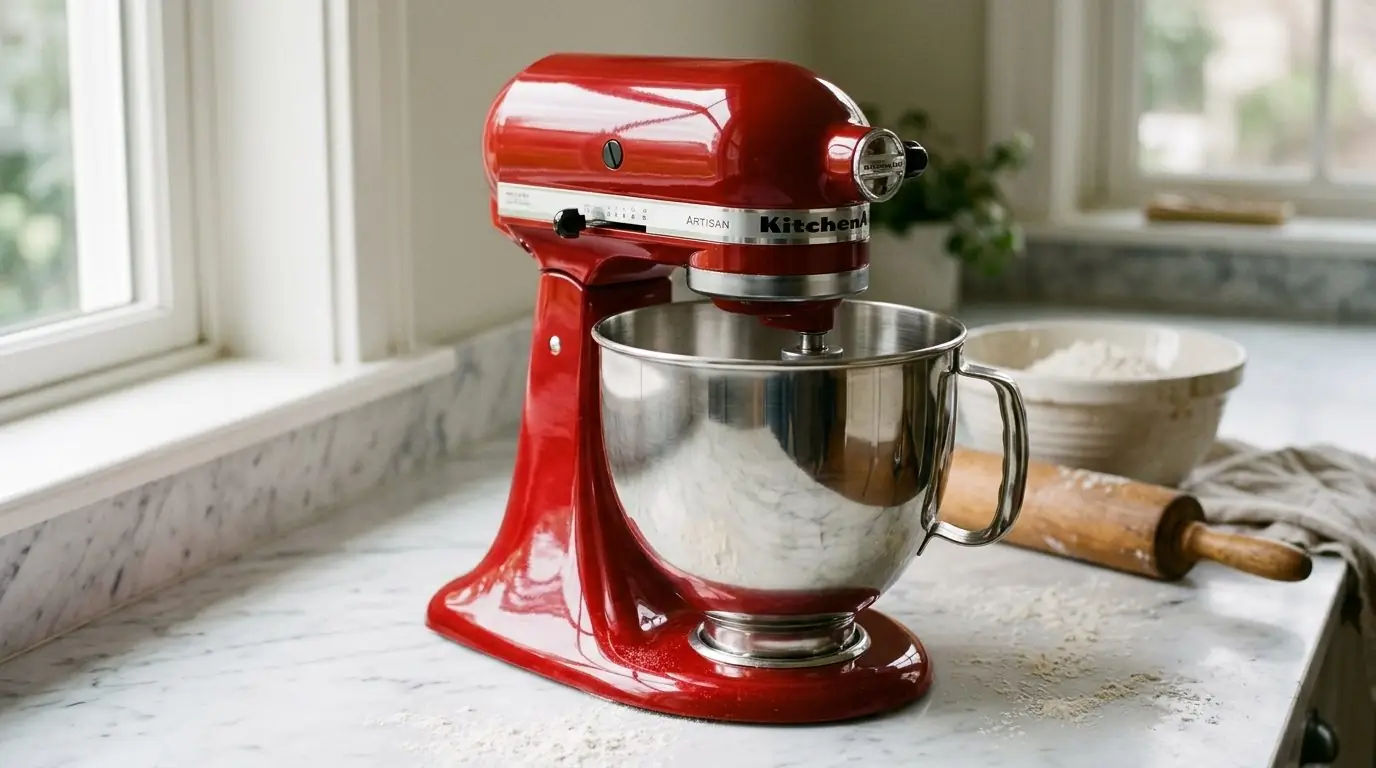
On wedding registries and kitchen design mood boards across the globe, one appliance reigns supreme: the KitchenAid Artisan 5-Quart Stand Mixer. Finished in glossy Empire Red, Pistachio, or Matte Cast Iron, this $450 machine is as much an interior design flex as it is a culinary tool.
Meanwhile, multi-cookers, food processors, and hand mixers flood discount retailers for $49 to $99, promising to mix cake batter and knead dough with lighter plastic bodies and digital touchscreens.
So we ask the fundamental engineering question: Is the KitchenAid Artisan genuinely special beneath its enamel paint? Or is it an outdated, overweight 1930s relic riding on nostalgic brand loyalty?
Listen to the 45-Second Verdict
Studio voice briefing • No fluff • Zero ads
1. The Engineering: Planetary Motion & Die-Cast Zinc
In 1919, an engineer named Herbert Johnston watched a baker struggle to mix bread dough with a heavy iron spoon. He realized human wrists move in two simultaneous circular planes.
The result of his observation was the Planetary Mixing Action, an engineering mechanism that KitchenAid patented and perfected:
        Planetary Mixing Geometry (59 Touchpoints)

                  ┌───────────────┐
                  │ Central Drive │
                  └───────┬───────┘
                          │ (Orbits clockwise)
                          ▼
                   [ Offset Beater ] ◄── (Spins counter-clockwise)
                          │
Bowl Wall ─────────┴───────── Center of Bowl- 59 Points of Contact: As the motor runs, the beater rotates on its own axis counter-clockwise while simultaneously orbiting the entire circumference of the bowl clockwise. This creates 59 distinct touchpoints per rotation, ensuring zero unmixed flour pockets without requiring human spatula scraping.
- 26 Pounds (11.8 kg) of Die-Cast Zinc Alloy: Modern kitchen gadgets bounce and dance across countertops when kneading stiff bread dough because their lightweight plastic frames flex. The KitchenAid chassis is solid, heavy die-cast metal. That mass anchors the center of gravity directly over the bowl.
- Direct-Drive All-Metal Gear Transmission: Unlike budget mixers that use elastic rubber belts (which stretch, slip, and snap under dense rye or sourdough loads), the Artisan uses a direct-drive worm gear train that transfers direct mechanical torque straight from the motor armature to the planetary spindle.
2. The Universal Attachment Hub (Since 1937)
Perhaps the most astonishing design decision in consumer electronics history happened in 1937, overseen by legendary industrial designer Egmont Arens.
Arens standardized the square power-takeoff socket on the front nose of the mixer. That exact same geometric socket specification exists today.
 1937 Attachment Specification  ═════►  2026 Modern KitchenAid Mixer
(Zero Planned Obsolescence)- A vintage cast-iron meat grinder manufactured during the Franklin D. Roosevelt administration in 1940 locks directly into a brand-new 2026 KitchenAid Artisan.
- You can attach pasta roller sets, sausage stuffers, grain mills, ice cream makers, and vegetable spiralizers directly to the motor spindle, turning one 325-watt motor into a complete commercial preparation station.
3. The Flaws: Where the Legend Shows Its Age
Even an industrial icon has genuine limitations you must know before spending $450:
- The Sacrificial Nylon Gear: Inside the gearbox, KitchenAid intentionally uses one nylon/composite worm follower gear. If you jam the beaters on a bone or solid frozen butter, this gear strips intentionally to prevent burning out the $150 electric motor. While it protects the motor, aggressive whole-wheat kneading will eventually strip this gear, requiring a messy grease-packed DIY repair.
- Tilt-Head Hinge Creep: Over years of heavy vibration, the central hinge pin can loosen, requiring you to perform the famous “dime adjustment test” using the internal flathead set-screw to recalibrate bowl clearance.
- Thermal Warmth During Dense Doughs: The Artisan uses an AC motor. When kneading stiff 50% hydration bagel dough for 10 consecutive minutes, the top motor housing becomes noticeably hot to the touch.
4. The True Cost-Per-Use (CPU) Equation
Can a $450 heavy metal mixer make financial sense over a $60 plastic mixer? Let us calculate the true lifetime economics of home baking:
The Real Long-Term Economics
Drag the sliders to see how an heirloom investment compares to disposable alternatives.
💎KitchenAid Artisan 5-Qt Mixer
Initial price: $450 (1-time purchase)
✓ 0 replacements needed • Lifetime warranty
⚠️Budget $60 Plastic Mixer
Initial price: $60 (chips every 3 years)
7 pots sent to landfill
Mathematical Insight: Over 20 years, the premium cookware saves you $70 in replacements and prevents 6 pots from going to a landfill.
5. The Special Index Breakdown
Is It Special?
✓What Makes It Special
- •59-point planetary mixing action creates complete, scrape-free ingredient integration
- •26 lb die-cast metal construction prevents countertop walking under heavy loads
- •Universal power hub fits vintage 1940s and modern 2026 attachments without adapters
- •Fully modular, repairable construction with abundant spare parts and grease repacking guides
- •Available in dozens of durable powder-coated enamel colors
✕Where The Hype Fails
- •Heavy to move in and out of cupboards (best left on permanent counter display)
- •Sacrificial internal gear can wear out under extreme, repetitive low-hydration bread doughs
- •AC motor head gets warm during extended high-torque kneading sessions
Check Real-Time Pricing & Stock
*Transparency: As an independent reviewer, we may earn a small referral commission at zero extra cost to you.
6. The Unvarnished Verdict
If you only bake cookies once a Christmas, buying a $450 KitchenAid is purely an aesthetic statement.
However, for anyone who bakes bread, whips delicate meringues, rolls fresh egg pasta, or values machinery built from honest metal rather than disposable plastic, the KitchenAid Artisan is not a luxury gimmick. It is an authentic industrial workhorse designed to be repaired rather than discarded.
On the Special Index, the KitchenAid Artisan earns a commanding 9.2/10: A True Gem.
Did you find this investigation helpful?
Give a heart to endorse 100% independent, sponsor-free product criticism.
✓ Recorded! Thank you for supporting independent testing.
IsItSpecial WhatsApp
Never miss an unvarnished teardown. Get instant drop notifications, verified buying links, and price alerts directly inside WhatsApp.
Join IsItSpecial Channel→Never miss an unvarnished verdict.
Deep materials science, industrial design history, and honest de-influencing. Zero corporate sponsored fluff. Unsubscribe anytime.
Powered by Substack • 100% spam-free • One-click unsubscribe
Is It Special Editorial Desk
Electromechanical & Industrial Design CriticWritten by our independent product & cultural testing desk. We purchase our own subjects, reject corporate sponsorship, and test items under everyday conditions to filter true quality from marketing hype.
Related Investigations
More critical teardowns in Craft & Design

Is Japanese Selvedge Denim Actually Special? Or Raw Fashion Pretension?
Why denim nerds happily pay $300 for jeans woven on vintage 1950s Toyoda shuttle looms in Okayama, Japan.

Is the $420 Le Creuset Dutch Oven Actually Special? Or Culinary Vanity?
A metallurgical inspection of France's iconic enameled cast iron cocotte. Why vitreous glass fused at 800°C outlasts cheap enamel, and whether it justifies a 600% price premium over Lodge.

Is the $360 Moccamaster Actually Special? An Engineer's Teardown
A mechanical inspection of the iconic Dutch drip machine. Does handcrafted copper-element heating justify a 10x price premium over standard coffee makers?

Is the $25 Lodge Cast Iron Skillet More Special Than a $300 Luxury Non-Stick Pan?
Why high-tech chemical non-stick cookware ends up in a landfill within three years, while a chunk of molten iron from Tennessee lasts four generations.